
As DOGE tears its way through the federal government, it would appear that the Department of Education is next on the chopping block for Donald Trump and Elon Musk. Musk and other DOGE employees have been operating at the Department of Education over the past two weeks and have specifically targeted the Department of Education’s research arm, with further steps to dismantle the department on the horizon.
What is Being Cut?
The Institute of Education Sciences (IES) has been the main target of the cuts to the Department of Education that have already taken place, with 89 contracts worth $881 million being cut. As well, another 29 contracts associated with diversity, equity, and inclusion have been cut. Earlier this month, dozens of employees were put on administrative leave for attending a diversity, equity, and inclusion training they were encouraged to attend in 2019. According to Politico, “The Department of Education on Wednesday fired at least 60 probationary employees and has begun distributing termination notices to workers in the offices for civil rights, federal student aid and communications, as well as its legal department.”
The Institute of Education Sciences (IES) is a division of the National Center for Education Statistics (NCES), which puts out the National Assessment of Education Progress (NAEP), also known as the Nation’s Report Card. IES’s primary purpose is to collect and provide data on effective teaching practices, student achievement, attendance, enrollment, and a number of other factors which state and local schools, universities, and researchers use to improve education for students. IES primarily operates through contractors who do things like study the implementation of teaching and testing strategies in classroom. Employees of IES’s now terminated contracts have raised concerns that the 89 contracts which are now cut short have wasted millions of dollars that have already been spent to implement programs like high quality, adaptive digital tools in math classes. Millions that have already been invested in contracts to study things like homeschooling, private school education, and career and technical education programs are also now down the drain.
Embed from Getty ImagesPresident Trump has appointed Linda McMahon for the role of Secretary of the Department of Education, who spoke of Trump’s plans for the Department of Education in her Senate confirmation hearings which are ongoing. She acknowledged that closing the Department of Education, “certainly does require congressional action”, and she maintained that Trump would preserve programs like Title I, Pell Grants, and Public Service Student Loan Forgiveness. She did assert that enforcement of the Individuals with Disabilities Education Act and the Civil Rights Office, “may well rest better” with the Department of Health and Human Services and Justice Department respectively. However, Trump and Musk have been telling a different story.
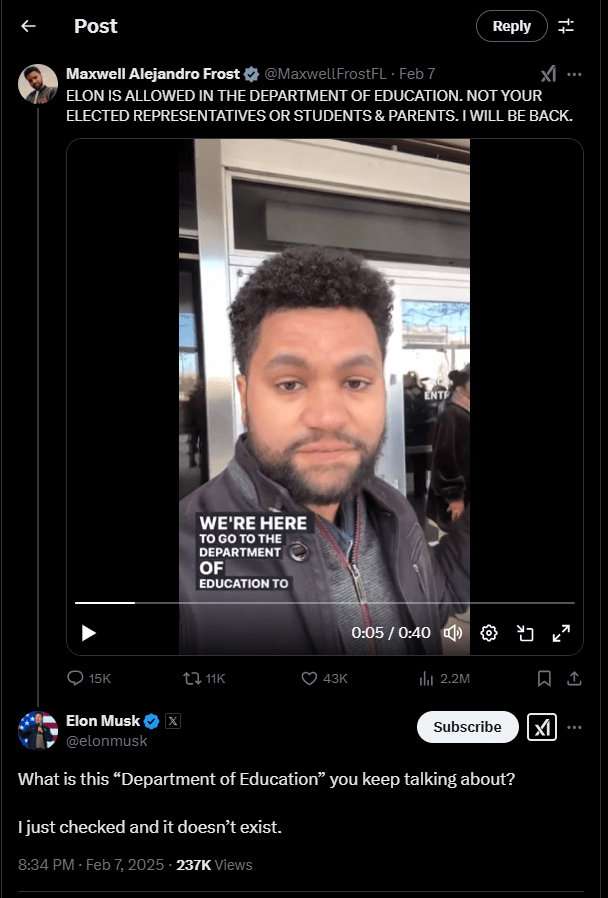
While McMahon fights backlash against cuts to the Department of Education in her hearings, Trump and Musk seem to be preparing to gut the department to the full extent of their power. Beyond Elon Musk taunting congress members on X that the Department of Education “doesn’t exist”, Trump stated in a press conference on February 4th, “I want Linda to put herself out of a job.” Furthermore, sources in the White House report that Trump is gearing up to sign an executive order with the intention of dismantling the Department of Education. The Associated Press reported, “The planned order would direct his education chief to start winding down the agency but urge Congress to pass a measure abolishing it, according to sources familiar with the plan.”
What Does the Department of Education Actually Do?
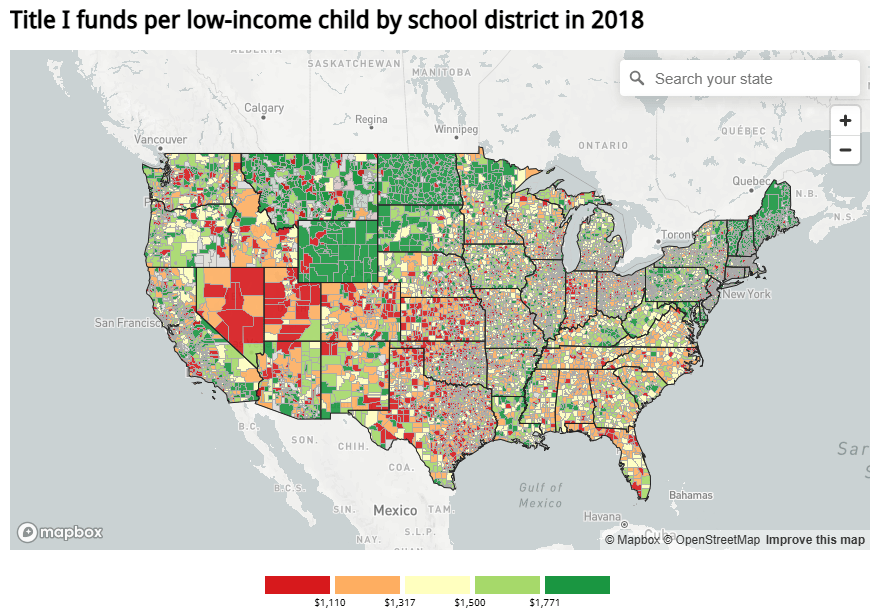
- Distribute Title I Funds: Title I federal funds to schools come from the Elementary and Secondary Education Act of 1965, an act designed to provide schools with high concentrations of low-income students with supplemental aid to improve opportunities for, “educationally deprived children.” While the phrase, “Title I Schools” invokes an image of urban, inner-city schools – which do ultimately benefit from Title I funding – the truth is that rural states and school districts are the primary beneficiaries of Title I federal funding. The following is an map that shows how much Title I funding every school district across the United States received in 2018. You can look interact with the map by following this link to the original article. This money is often given to schools as a base grant that allows them to spend the money where they need it most, whether that be on hiring more teachers to lower teacher to student ratios, providing students with clothes and food to increase attendance, or create after school programs to keep students in school.
- Distribute IDEA Funds: IDEA or the Individuals with Disabilities Education Act provides funding to schools to help accommodate students with learning disabilities such as ADHD, Dyslexia, and Autism as well as students with physical disabilities. Often this money goes towards funding training for teachers who teach these students, hiring ESE specialists and counselors who can aid teachers and parents to make sure students receive their accommodations, and provide resources like tools and technology to assist these students.
- Enforce Title IX and VI Regulations: Title IX and VI, passed by congress under the Education Amendments of 1972 was created to prevent discrimination in primary, secondary, and higher education based on gender, race, or national origin. This includes handling cases of sexual harassment, protections for pregnant students, expansion of girls and women’s athletic programs, gender and race conscious affirmative action programs at universities, and bolstering programs for women in STEM (Science, Technology, Engineering, and Mathematics) and CTE (Career and Technical Education).
- National Center for Education Statistics (NCES): NCES does a number of tasks including gathering data and statistics on colleges and universities as well as states and local school districts. This data, which is gathered in coordination with IES (Institute of Education Sciences) is used to produce the National Assessment of Educational Progress (NAEP), also known as the Nation’s Report Card, which provides a look at student achievement in reading, math, and science. This data is also used to rank schools as A, B, C, D, or F schools and provide information on best teaching practices to improve student learning.
- FAFSA, Student Loans, PELL Grants, and Public Service Loan Forgiveness: The Department of Education processes the Free Application for Federal Student Aid (FAFSA) which provides college students with student loan money to pay tuition. They also manage $1.6 Trillion in student loan debt. The department administers Pell Grant money from the Higher Education Act of 1965, which provided $31 billion in aid to nearly 6.5 million students in 2023. Pell grants are intended to provide students who otherwise would not be able to afford to attend college due to financial need with money to attend. The department also processes Public Service Loan Forgiveness, which forgives the remaining federal student loan debt for individuals who work for federal, state, or local government office for eight years while paying on their student loans. Teachers are often beneficiaries of this program.
The History of the Department of Education:
1867: The Department of Education is First Founded. Created by legislation signed by Andrew Jackson, the department is tasked with gathering information and statistics about American schools.
1868: The Department is Demoted to the Office of Education. For fear that the Department of Education would have too much control over local schools, congress passed legislation demoting the DoE to a government office. It was housed in variance agencies over the years, including the Department of Interior then the former Department of Health Education and Welfare (now the Department of Health and Human Services).
1950s: Political and Social Changes Spark Expansion of Federal Funding for Education. The great space race also expanded federal funding to science programs across the nation.
1960s: Lyndon B. Johnson’s “War on Poverty” Increases Federal Funding for Low Income Students.
1970s: Efforts to Expand Educational Opportunities for Women, Racial Minorities, the Disabled, and Non-English Speaking Students Take Off.
1979-1980: Congress Passes the Department of Education Organization Act, the Department of Education is Established, and it Begins Operation.
What Happens if the Department is Dismantled?
It’s become apparent that the Department of Education at risk of experiencing deep cuts, but what the dismantlement of such an organization would result in is only speculation. As an educator myself, I will do the best with the data provided and my personal experiences to paint a picture of a future without the Department of Education. Although Donald Trump has repeatedly tried to distance himself from Project 2025, which also calls for dismantling the Department of Education, he has tapped several Project 2025 contributors as members of his cabinet, and many of his policies align with the far-right blueprint for American politics. With this in mind, I will be considering what could happen if some of the policies proposed in Project 2025 were implemented.
Project 2025 proposes transferring Title I funds to a “no strings attached block grant” which will be phased out over the course of ten years in which revenue responsibility will be given back to the states. Considering that 10 states, all of which are considered Republican, rely on federal funding for more than 15% of their state education budget, most of which comes in the form of Title I funds, this will significantly impact the ability of poor, rural states to provide quality education. 13.5% of Florida’s education budget comes from federal funding, a percentage which will likely have to be made up for in tax policies implemented by states, counties, and municipalities if it were to disappear. Citrus County Schools, where I live, received $5,846,289 in the 2022-2023 Fiscal Year. If this funding were to disappear, it would likely result in increased teacher to student ratios (more students per teacher), reduced course availability, and reduction of other programs that keep children in school. Furthermore, the DOGE goal of saving taxpayers money becomes a moot point if citizens have to turn around and fund education through state and local taxes.
Other proposals include converting IDEA funding to a “no strings attached block grant”, though it does say whether this would also be phased out and made the states’ responsibility like Title I, as well as reducing the number of schools who qualify for free and reduced lunch programs and eliminating Impact Aid, which provides schools who lose money in property taxes due to federally owned land like Indian Reservations, Military Bases, and Low Income Housing with enough income to function. Furthermore, like Linda McMahon, it proposes moving several of the functions of the Department of Education to other government departments.
As a teacher who worked for a Title I school last year, I want to paint you a picture of the situation presently at hand. Each year, more and more elective courses are cut, limiting the availability of arts programs to impoverished students and placing a greater burden on teachers. I taught three subjects: English III, Film, and Theater. Most of my eleventh-grade students read at a sixth or seventh-grade level. Students were flooded into my theater classes because they need a performing arts credit to graduate under Florida law, and the choir program had been cut, leaving their options between theater or band. Because my classes took place in the auditorium, a building that is a health hazard to say the least, and there is no law limiting students in elective courses, the teacher to student ratio was 1 to 55. That one teacher was me, a fresh out of college graduate with no background in theater just trying to do their best. It’s not a wonder the two teachers before me quit within their first year.
What’s worse: some of the students I taught depended on getting breakfast, lunch, and dinner at school, and more than one student I knew was homeless. Most of the teachers, like me, were teaching three separate courses, many with classes of 30 students or more, and running an after-school program. I cannot overstate the stress of working in these conditions, and reductions in federal funding, much of which goes towards lowering student to teacher ratios (which studies show improves graduation rates and student success after graduating), will only exacerbate these issues and lead to teacher shortages across the nation. The present issue is this: our public schools, which millions of students depend on, need help, and cutting their federal funding will only make the situation worse.
Here’s a picture of me operating lights and sound for my school’s production of Romeo and Juliet last fall:

When you are preserving Title I funding, you’re preserving moments like this. Title I helps to keep teachers like me empowering students to express themselves, build connections and confidence, gain cultural knowledge, and improve their understanding of the English language. US public schools are already stretching every cent to the max, and when funds are cut, the arts will be the first to go.
Is There an Upside?
Some GOP lawmakers in states argue that removing red tape and burdensome reporting requirements for their schools will empower states and local school districts to make better decisions about where federal funding goes. Frank Edelblut, Republican Commissioner of the New Hampshire Department of Education says that each state has “different needs in order to serve our communities, to meet the educational objectives and needs of our children in our state…And so, we may have to do things differently. And so, I think, really, the conversation around providing states greater control over education is a really important and a healthy one.” It is important to note that the Department of Education has no control over the curriculum each state uses, but a small portion of the money provided through federal funding is tied to achievement incentives which takes into account what each school and state’s test scores are.
Are the Cuts Worth the Cost?
The Department of Education’s budget makes up around 4% of all federal spending and costed $268.35 billion in 2024. The following chart shows a breakdown of where the money goes within the department:
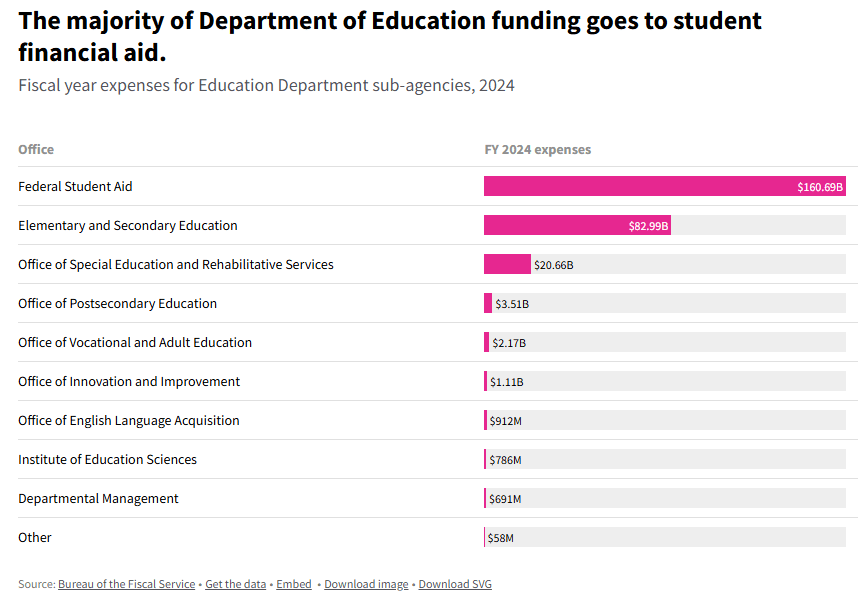
Considering that many of the proposals outlined by Linda McMahon and project 2025 entail just moving some of these functions to other departments, it is unknown how much money would be saved, if any, by doing so. Furthermore, the $881 million DOGE claims has been saved by cancelling IES contracts, is less than 1/400th of the $400 billion the Congressional Budget Office estimates the Tax Cuts and Jobs Act will cost in revenue loss in 2025. Even if IDEA and Title I funding, classified under “Elementary and Secondary Education” were to be cut, it would cover less than 1/4th of the cost of the Tax Cuts and Jobs Act. Considering that no state has been able to return to pre-pandemic math and reading levels, it may be more important that ever to study and understand why student’s reading and math skills are suffering and how to improve – something IES was setting out to accomplish. Furthermore, long term studies have shown that federal funding increases to schools has led to increased graduation rates, increased post-secondary enrollment, and increased wages for graduates in the years after school. This begs the question, is it wise to make cuts or reforms in the Department of Education, and how can we do so without negatively impacting local schools and students?
The Trump Budget Series
This is the third installment of the Trump Budget Series, a series of posts tackling how and why DOGE and the Trump Administration are cutting federal spending. I highly recommend checking out “The Trump Tax” and “Trump Cuts the Federal Workforce” to gain a broader perspective of the context of these cuts. Although I will be taking a short break from the series next week to write a different style of article, there is more to come to keep you up to date on news surrounding DOGE and the Trump Administration and how it may impact you.


 The Citrus Peel
Leave a reply to Josh Weil, Democrat, Runs for US House Seat in Special Election – The Citrus Peel Cancel reply