
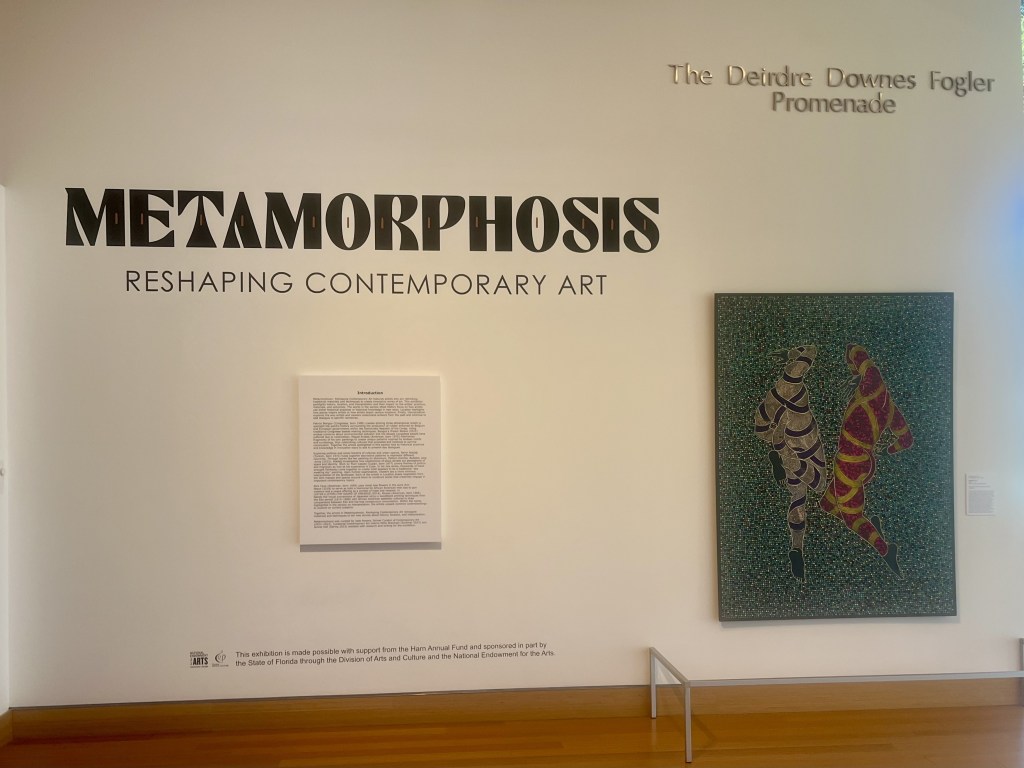
If you read my last post about my recent viewing of Tchaikovsky’s The Nutcracker, what you don’t know was that I arrived about an hour early to the show. What to do with so much time to kill? Luckily, The University of Florida’s Harn Museum of Art was just next door and free to visit. I have been lucky enough to have enjoyed Harn’s collection before, but I had just enough time to view their contemporary art exhibit: Metamorphosis.
Metamorphosis, according to the curator, “…features artist who are rethinking traditional materials and techniques to create innovative works of art.” For example, the artist below blends abstract, contemporary themes with traditional weaving techniques from Bolivian Indigenous textile work to create his masterpiece. Another artist, not shown here, used hooks to create ocean waves, representing the threat of overfishing and pollution by transforming remnants of these practices into the places they affect most.

The piece, La Ofrenda, created by artist Miguel Arzabe was created by analyzing and deconstructing two other paintings which Arzabe used to emphasize Andean symbols and motifs. It is easy to see the piece’s connection to Arzabe’s Andean heritage and the textiles of Bolivian weavers in its patterns and woven canvas which come together to create something both traditional and unique.
The next two pieces by Italian artist, Francesco Clemente, transpose the war time diary and travelogue of Italian writer, composer, and painter, Alberto Savinio, The Departure of the Argonaut. The story details the author’s journey from Ferrara, Italy to the Salonika front during World War One.

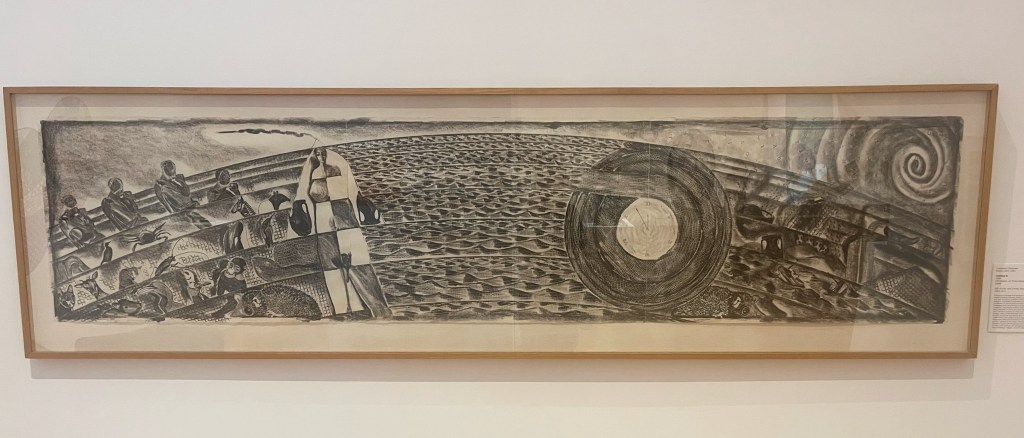
I found the mythological, nautical, and spiritual elements that Clemente includes in the piece to be particularly striking. The medium of lithography on paper is poignant in that it seems to reflect the original story’s printed pages from Savinio’s book.
The next artist transformed fabrics saved from her wedding trousseau from the 1920s to create fabric scarves arranged into a vivid display of remembrance.

Louise Bougeois’ parents owned a tapestry restoration business, and the scarves above are repurposed from napkins, tablecloths, and nightgowns to create her collage, Ode a l’Oubli (Ode to Forgetting). One framed work I find particularly interesting reads, “I had a flashback of something that never existed.” This phrase, I think, perfectly captures the phenomenon of memory, which creates and recreates the stories of our lives. The artist created this in 2004, when she was an astonishing 93 years old!

The next piece called Arm Peace by artist Nick Cave, acts as a memorial to the lives of black men lost to gun violence. The sculpture is laden with flowers, adding a sobering touch to the metallic sculpture that beautifully captures light and hope for a brighter future.

Like the piece above, the next piece both captures beautiful lighting and challenges racial power structures, this time through portraiture.

Titled Margaret, Countess of Blessington, in reference to the painting whose image is shown to the left, the artist, Kehinde Wiley, paints portraits of black men in Harlem in the style of 19th century historical works. These works subvert the paintings they are based off of by centering black figures in vivid dress rather than the traditional wealthy, white aristocrats of the 19th century. I particularly love the contrasting patterns in this painting, from the floral background to the beautiful textiles that add amazing texture to the work. If you notice, the positioning of the subjects’ hands in both this piece and the reference painting are the same. Absolutely brilliant.
I’ve saved my favorite piece for last, and I hope you’ll see why I’m totally obsessed.

This sculpture, made of ceramics and a tea pot, by artist Kimiyo Mishima, is titled Box Orange – 05T. Mishima has been creating ultra-realistic ceramics of everyday waste since the 1970s that express human greed and wastefulness. She takes inspiration from the Japanese movement of the Gutai Art Association, which seeks to use a wide range of materials to explore the relationship between these materials and the human spirit. Mishima perfectly captures the spirit of Metamorphosis through her use of silk screening and transfer paper to create crumpled ceramic newspapers! These crumpled newspapers still baffle me, along with the frayed edges of the “carboard” box and bright orange advertisement.
Metamorphosis did what any good exhibit strives to do, and it challenged me to think deeply, in this case about the materials and forms of art being recreated to send a message. Although I was unable to include every piece from the exhibit here, I hope that if you’re in the Gainesville area that you check out the Harn Museum of Art and see these pieces for yourself or check out their website here.

 The Citrus Peel
Leave a comment