
With only hours left on election day and votes being tallied all across the country, election season in the United States is swiftly coming to a close. As ballots are being cast and counted, it’s worth reflecting on each campaign, what made these campaigns unique, and which strategies were successful. Between Donald Trump’s two assassination attempts and Kamala Harris’ switch from Vice President to Democratic frontrunner, this election season has been anything but boring and each candidate’s campaign has branded itself with specific trademarks in an attempt to win Tuesday’s election with varying degrees of success. Here, we will review each campaign’s strategies and reflect on each candidate’s strengths and weaknesses.
Team Harris-Walz
Kamala Harris and Tim Walz have implemented a clear, focused strategies that have targeted two primary groups of voters: young voters (Gen-Z and Millennials) and swing voters, particularly from suburban areas. These are not uncommon demographics to target, especially considering that a win on election day will hinge on seven key swing states, but the way Harris executed her strategy is unique to her campaign.
Kamala is Brat
Perhaps both Kamala’s effort at targeting Gen-Z voters and her success in this endeavor can be summed up in one simple phrase: “Kamala is Brat”. Artist Charli XCX, who went viral this summer for her album “brat”, posted this phrase on X shortly after President Biden stepped down and endorsed his former running mate for president. In the midst of what was coined “Brat Summer”, Kamala Harris experienced an unprecedented level of virality and massive support in the forms of donations.
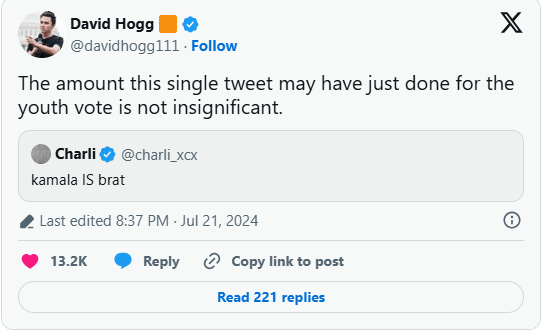
This tweet by David Hogg, former student at Marjory Stoneman Douglas High School in Parkland, Florida, is a 24-year-old activist and co-founder of the March for Our Lives movement, underlines the significance of those three little words.
Between the virality of “You think you just fell out of a coconut tree?” and “Kamala is Brat”, the Vice President was certainly having a moment, especially considering she raised over $81 Million Dollars in the first 24 hours of her campaign. And this celebrity endorsement was just the first of many. From Megan Thee Stallion to Lizzo to President Barack Obama, Harris has pulled out all the stops at her star-studded rallies and has received official endorsements from key Gen-Z artists like Taylor Swift, Olivia Rodrigo, and Billie Eilish. Still, the question of whether or not this strategic use of celebrity endorsements will be enough to motivate Gen-Z voters is still up in the air. In 2020, Bernie Sanders gained significant popularity among college students with his promises to wipe out student-loan debt but still fell short of becoming the Democratic frontrunner. However, while Berine’s policies appealed directly to young, progressive voters, Harris is marketing herself as the safe, experienced candidate, appealing to voters from various backgrounds and viewpoints. Not to mention, one can’t help but recall what happened to NFL ticket prices when Taylor Swift announced her relationship to quarterback Travis Kelsie. Could the same thing happen at the polls? Only time will tell.
Coach Walz and District Attorney Harris
Embed from Getty ImagesIt’s no secret that in every campaign there will be some level of villainization of one’s opponent, but equally as important is the characterization of the candidate themself, and Harris’ campaign has had varying levels of success in both of these endeavors. Harris has repeatedly characterized herself as a public servant, drawing on her experience as a District Attorney in San Francisco to paint a picture of someone who has and will fight for those in need.
In a conversation on NPR, a look back at Kamala’s career as a District Attorney reveals a similar conflict to the one she faces today. As she built the trust of the local police, she was criticized by more progressive Democrats who felt she wasn’t doing enough to curb police brutality. Similarly, Harris faced pressure from pro-Palestine protestors at the Democratic National Convention and at her rallies, but she has remained firm in her support of Israel, though she has said that she is working to seek a ceasefire. Throughout her campaign, Harris has worked hard to win swing voters, and this clearly involves a reframing of certain issues and a focus on issues that are non-controversial such as prescription drug costs, job creation, and economic assistance for first time home buyers.
Perhaps more powerful than the image of Harris as the former District Attorney is her running mate Walz as the midwestern Football Coach, Teacher, Veteran, and Dad. Boy is that a potent combo. Similarly, Walz has focused on career achievements such as securing free school lunches as Governor of Minnesota, serving as faculty advisor for his school’s Gay-Straight Alliance in 1999, and serving as a ranking member on the House Committee on Veterans’ Affairs in 2017. Between his rural upbringing, midwestern ties, and “A” rating by the NRA, Walz may be Harris’ greatest tool in winning swing voters. However, it is important to note, it is a delicate balance to maintain winning more conservative, swing voters while not alienating more progressive supporters.
Meanwhile, while Harris and Walz have worked hard to build an image of themselves in the minds of voters, they have also worked to create an image of the other guys. Harris’ campaign has repeatedly tied the Trump-Vance candidacy to Project 2025, a set of policy guidelines published by The Heritage Foundation with policies including the abolishment of The Department of Education, a call for the FDA to revoke its approval of Mifepristone, a medication used to provide abortions, and making significant cuts to Medicaid and reforming Medicare. Both Harris and Walz have called Trump and Vance “just weird“, referencing Vance’s criticism of democratic party leaders like Harris as “childless cat ladies“.
What About the Issues?
While Harris and Walz have brought up a variety of issues, they’ve had two main areas of focus: the economy and women’s reproductive rights.
Kamala Harris has proposed an economic plan focusing on three main policies:
- Support for New Families and First-Time Home-Buyers: Harris proposed a $25,000 subsidy for first-time home-buyers and up to $6,000 in assistance per child to families within the first year of the child’s life.
- A Federal Ban on Grocery Price-Gouging: If it went into effect, this policy would authorize the Federal Trade Commission to levy fines against grocery store chains that implement excessive price hikes.
- A Recommitment to the Inflation Reduction Act: Biden’s Inflation Reduction Act capped Insulin prices at $35 per refill and limited out of pocket costs to $2,000 per year for Medicare beneficiaries. Harris’ plan would extend these policies to all Americans.
These policy issues target those two key demographic areas, Gen-Z and Millennials and swing voters, in two ways. The oldest of Gen-Z Americans are now well into their twenties and are seeking to buy houses and start families just like their Millennial counterparts. While those two issues in particular target young voters, everyone has experienced the cost of inflation at the grocery store and according to the CDC 64.8% of Americans over the age of 18 are on prescription medication. But these issues do double duty: they effect Americans in every age group and they lack the controversy that will alienate swing voters.
However, while abortion has been and will remain a controversial issue, Harris’ campaign has made their best effort to frame the issue in a different light: Women’s Reproductive Healthcare. Since Roe V. Wade was overturned in June of 2022, 14 states have implemented a near total abortion ban and three more have a ban after 6-weeks (before most women know their pregnant). Harris’ campaign has been laser focused on amplifying the importance of this issue since the beginning, citing Harris’ work as Vice President towards protecting women’s reproductive rights. Most recently, Harris chose a rally in Houston, Texas to platform the voices of doctor’s and families alike who have experienced the difficulties laws like those in Texas present.
Embed from Getty ImagesHarris’ Houston rally showcased an OB/GYN who spoke about the legal threats to doctors who perform abortions and Amanda and Josh Zurawski, a couple who had to seek a life-saving abortion when complications arose during Amanda’s pregnancy. Due to Texas’ abortion ban, Amanda had to wait until her life was in jeopardy before an abortion could be performed. According to an article published in NBC news, “From 2019 to 2022, the rate of maternal mortality cases in Texas rose by 56%, compared with just 11% nationwide during the same time period, according to an analysis by the Gender Equity Policy Institute. The nonprofit research group scoured publicly available reports from the Centers for Disease Control and Prevention and shared the analysis exclusively with NBC News.” This reframing of abortion as an issue of women’s health has been instrumental in Harris winning swing voters who might be alienated by Trump’s pendulum swing from celebrating the overturning of Roe V. Wade to claiming he would veto an abortion ban if it came across his desk.
Harris-Walz in Review
Although Harris came into the game late, it is clear that her team has more than made up for lost time, and one might even argue that timing has been key for the Vice President. Harris’ campaign knows what it wants, what it needs, and it has a laser focus. The greatest challenge Harris’ campaign faces, and what we will only find out once the votes are counted, is whether or not Harris has been able to pull in swing voters without losing progressive supporters. Both the greatest weakness and the greatest strength of this campaign lies in Harris being the “safe” candidate in comparison to Donald Trump. The question remains: does this mean the status quo will continue? Harris has repeatedly stood by President Biden, who has been criticized by both swing voters and progressive democrats alike, but she has also proposed changes and iterated in an interview with NBC, “Mine will not be a continuation of the Biden administration. I bring my own experiences, my own ideas to it.” While Harris has expertly played the field with her framing of issues, it is yet unclear whether or not she has set herself apart from President Biden in the minds of voters.
Team Trump-Vance
Where Team Harris-Walz gains its power from its laser focus and calculated strategy, Team Trump-Vance relies far more on unleashing the power of Trump. In past elections, Trump gained success from his unpredictability, tweets, and his star power. However, after the loss of the 2020 election to President Biden and the loss of the use of Twitter (now known as X), the Trump campaign has taken a turn towards more focused strategy while attempting to maintain the momentum that Trump’s star power brings from his voter base.
Businessman, Underdog, Patriot
While we’re all familiar with Trump’s ability to cast his opponent in an unfavorable light, but he has also had success in creating an image of strength in the minds of voters. In 2016, Trump gained traction painting himself as a no-nonsense businessman who appealed to fiscal conservatives with his vows to run the government like a business, boost the economy, and cut spending. His catchphrases like “fake news”, caught on with voters who were frustrated with the national news media and felt that Trump “tells it like it is”. However, after the loss of the 2020 election and the messy transition of power that culminated in the January 6th insurrection, there has been a necessary shift in strategy the builds off of this loss and other challenges that Trump faced during his campaign.
The major event in Trump’s campaign that most closely coincides with Biden’s endorsement of Kamala Harris as the Democratic frontrunner, is the assassination attempt on Trump at his rally in Pennsylvania. This took place just before the Republican National Convention and gave Trump something to come back from with strength.
Embed from Getty ImagesTrump’s bandage on his right ear from being grazed by a bullet became a symbol resiliency in his campaign, which already relied heavily on Trump’s bullish narrative. It even became a fashion statement for some of his most staunch supporters.
Embed from Getty ImagesThen there was of course the introduction and characterization of JD Vance, Trump’s running mate. Patriotism is an instrumental part of any presidential campaign, and it is most certainly a cornerstone of the image Trump strives to build in the mind of voters. Harris and Trump both made a calculated choice when picking a running mate, and, on the surface, both running mates have a similar profile: military veteran politician with a rural background and a traditional, nuclear family.
The Senator from Ohio served as a combat correspondent for nearly four years in the US Marine Corp, and he is also known for his memoir, Hillbilly Elegy, which depicts Vance’s Appalachian family which struggled with poverty and drug addiction and how he rose to overcome this. This rags to riches story both juxtaposes Trump’s less relatable background (for rural swing voters) as a wealthy New Yorker and ties in perfectly with his image as the underdog in this election. It evokes the “pull yourself up by your bootstraps” mentality that appeals to much of Trump’s base.
Vance is also a family man. His wife and two kids regularly come up in his campaign speeches, creating a rhetoric that appeals to a wide variety of voters by reminding them of how this election effects their future. However, not all of Vance’s ideas about family are popular, and a comment he made in an interview in 2021 that the Democratic Party was run by “childless cat ladies” has come back to bite him in this election. Even Taylor Swift, in her letter of endorsement for Kamala Harris on Instagram signed it, “Taylor Swift, Childless Cat Lady”. Vance responded to criticism over the comment in an interview with Megyn Kelly, “It’s not a criticism of people who don’t have children. I explicitly said in my remarks … this is not about criticizing people who for various reasons don’t have kids. This is about criticizing the Democratic Party for becoming anti-family and anti-child.”
However, with all the characterization of themselves as the underdogs and patriots, Trump and Vance’s campaign, similarly to both Trump’s 2016 and 2020 campaigns for president, focus just as much on painting their opponents in an unfavorable light. At a rally in La Crosse, Wisconsin, Trump stated in regard to Kamala Harris, “She is in fact a Marxist-slash-communist.” and has repeated the claim that the Vice President is a Marxist throughout his campaign. By now, American voters know that Trump tends to go to extremes in his characterizations of his opponents, but Vance follows a line of rhetoric more commonly use in recent years by the GOP: that the democratic party is too “woke” and disconnected from the average, American family.
The Good Ol’ Days
One thing unique about this year’s election, is that both candidates have both the advantage and disadvantage of a track record in, or, in the Vice President’s case, working with the Presidential office. Just as Kamala Harris is making use of the gains of the Biden administration from the Inflation Reduction Act, so too is Donald Trump calling back voter’s minds to the days he was in office. While, of course, Trump’s final days in office were marked by the pandemic and January 6th insurrection, he’s drawn attention to differences in the economy, vowing to bring back policies used while he was in office such as lowering taxes and implementing tariffs. However, like much of the rest of Trump’s campaign, Trump has also had to be on the defense when referencing his time in office. Trump has faced a variety of lawsuits throughout his campaign and may still face charges over inciting the events of January 6th. Similarly, Kamala Harris has faced criticisms over President Biden’s handling Israel’s war on Palestine from progressives and border security from swing voters. It is clear that both Trump and Harris referencing their time in their respective offices is a double-edged sword.
The Issues
While Trump has articulated more than 100 campaign promises on policy since his bid for the election in 2022, he has centered his focus around a few key issues:
- Cutting Taxes and Implementing Tariffs: Trump has vowed to create a “middle class, upper class, lower class, business class, big tax cut.” He did lower tax cuts for these income groups while in office as president, however, this cut disproportionately benefited the very wealthy in comparison to other income groups. He has also proposed popular ideas like no tax on tips and ending taxation on social security. The other part of his economic plan, although this is also related to foreign policy, involves a 60% tariff on all goods imported from China. While this holds in line with his pledges to show strength against countries like China and Russia, Senate Republicans have expressed concerns in regard to such high tariffs. While the use of tariffs would balance out with lower taxes in terms of government revenue, the concern is that American families would ultimately pay the price in higher costs on goods.
- Border Security and Immigration: Trump has returned to promises of the creation of a border wall, an end to birthright citizenship, and a restoration and expansion of a travel ban on seven Muslim-majority countries. The US southern border is one area that the Biden-Harris administration has faced criticism over as the pressure from immigration rises. The issue of drug-trafficking across the US-Mexico border bringing deadly Fentanyl into the US has given Trump a foundation on which to build his arguments for stronger border policies.
- Military Strength: Trump has promised to end the Russia-Ukraine War within 24-hours and has repeatedly criticized the Biden-Harris administration for backing Ukraine. He plans to increase military funding and pursue Iron Dome technology, currently used to prevent missile strikes in Israel, for the United States. In foreign policy, along with Tariffs, Trump proposes targeting Chinese ownership of vital US infrastructure and partnering with businesses and universities to prevent cyber-attacks.
Overall, the issues Trump presents are ones that strongly align with his image and his voter base. Trump is known for his “America First” rhetoric, which he often promises to uphold through trade deals and foreign policy. Lower taxes will certainly appeal to voters struggling with the burdens of inflation. Fear, like in the economy, plays no small role in elections, and Trump’s promises to end and prevent wars and bring order to immigration will certainly appeal to his base and some swing voters who are dissatisfied with the Biden administration.
Trump in Review:
Trump’s weaknesses lie with his strengths, which makes evaluating his campaign difficult. On one hand, his unpredictable nature and candid speech is popular with his base, but his crass comments often gives his opponents ammunition. His track record in office can be used to support his campaign with voters who like his approach to economic and foreign policy, but some of his actions as president have made swing voters and previous supporters leery of supporting a second term. Just as Harris would do well to distance herself from Biden, Trump would do well to distance himself from previous versions of himself. This is an election that will likely be decided by economic issues, and Trump will have served himself best by drawing attention to those issues and exploiting voter dissatisfaction with the status quo.
Closing Thoughts
With only hours left in this election, overall, the success or failure of these campaigns rides on their ability to win the vote. This has been a unique election to say the least, and, no doubt, it will be close. As votes are counted into the night, we can only reflect on each campaign, their successes and failures, and the promises of each candidate that are yet to be fulfilled. May we all be a little lighter knowing, no matter the results, that are votes our cast and our voices heard.

 The Citrus Peel
Leave a comment